Source illustrationAbout this image
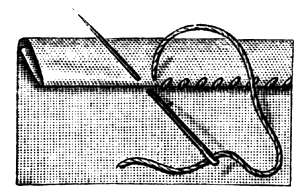
Figure 8 from Dillmont’s Encyclopedia of Needlework shows a turned hem. McGlauflin gives the towel instructions but no finished-project photograph.Historical pattern · Modern adaptation
Miniature hemmed towel
A small school exercise in folding and hemming a woven cloth, finished with a tape loop.
Before you begin
Materials
- A firm woven cotton or linen rectangle, 9 × 6 in
- Sewing thread suitable for the cloth
- Hand-sewing needle
- 4½ in of washable tape
- Pins or clips, scissors, ruler, and iron
Quick reference
Abbreviations
- Baste
- Use long temporary stitches to hold folded fabric in place before sewing the permanent hem.
- Backstitch
- Make a strong stitch by going back to the previous stitch endpoint before bringing the needle up ahead.
One step at a time
Step-by-step instructions
- 1
Cut the miniature cloth
Cut a woven cloth rectangle measuring 9 inches across the woof and 6 inches along the warp, following the source’s dimensions. The source specifies crash fabric; if you use a different cloth, check that it folds neatly.
- 2
Fold the sides and bottom
Turn a quarter inch to the wrong side along both sides and across the bottom. Baste the folds. Turn another quarter-inch fold on each side and baste again.
- 3
Hem the sides and bottom
Sew the side hems. At the bottom, turn a one-inch hem, baste, and sew it down. At each corner, keep the bottom hem folded over the side hems so the layers lie flat.
- 4
Finish the top edge
If the top has no selvedge, turn and sew a quarter-inch hem there. If it has a stable selvedge, the source leaves that edge unhemmed.
- 5
Add the tape loop
Turn each end of the 4½-inch tape under by a quarter inch. Place the ends side by side on the selvedge, about a quarter inch down from the top edge. Hem around the tape ends, then backstitch across the tape at the towel edge.
- 6
Press and inspect
Remove any visible basting and press the miniature towel. Check that the corners are secure and that the loop is firmly attached. The source describes a small school exercise, not a full-sized household towel.
Modern adaptation. Check materials, measurements, and gauge before beginning.
Historical pattern · Modern adaptation
From Handicraft for Girls
Original heading: Hemming a Towel · Chapter II, “Hemming a Towel,” Exercise No. 8, printed p. 16
Read the original wording and adaptation notes
Original wording
Materials: Crash, 9" woof, 6" warp; white thread No. 50; needle No. 7; tape 4½ inches. Turn one-fourth inch fold on each side and across the bottom and baste. Turn the second fold one-fourth of an inch on the sides and baste. Hem the sides. Turn an inch hem at the bottom, baste and hem, giving special attention to the corners where the bottom hem is turned over the side hems. Hem the top with a quarter-inch hem if there is no selvedge. Sew a loop in the middle of the top on the selvedge edge as follows: Turn in one-fourth of an inch at both ends of the tape. Place the ends of the tape side by side and down one-fourth of an inch from the edge of the towel. Hem around the ends of the tape and back-stitch across the tape just at the edge of the towel.
What changed for this modern edition
- The 9 × 6 inch cloth and 4½ inch tape are source dimensions. Current fabric and thread choices are modern substitutions.
- The historical source identifies warp and woof orientation. Preserve the stated dimensions when cutting, and use a selvedge at the top if available.
- This is a miniature school exercise. Scaling it to a kitchen or bath towel would be a separate adaptation.
- The modern steps have not been physically sample-sewn.
View the original source illustration
Public domain in the USA. Rights status can differ outside the United States.
View the digitized book at Project GutenbergThe copyright page gives 1910. The title page identifies McGlauflin as supervisor of girls’ handwork in the Denver Public Schools.
Maker notes
Your shelf
Sign in to save projects across devices and share your making.
Finished projects
No makers have shared a finished version yet.
Questions and notes
No comments yet. You can be the first to share a useful note.