Source illustrationAbout this image
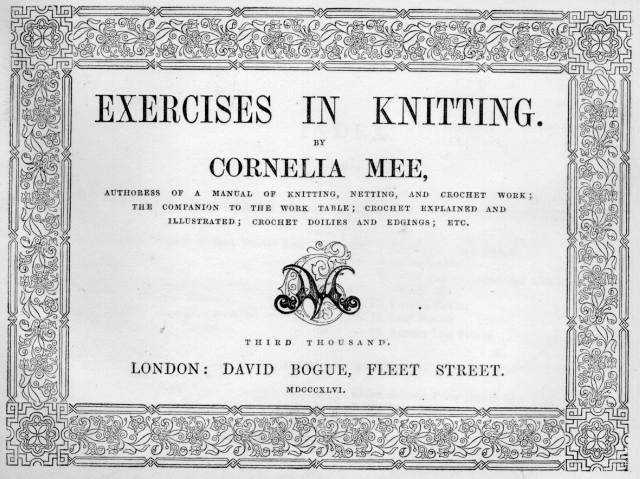
The source gives written rows for this edging but no illustration of the edging itself. This is the book’s title page.Historical pattern · Modern adaptation
Narrow Vandyke knitted edging
An eight-row lace repeat that forms a narrow pointed edge. The source terminology is translated in the modern steps.
Before you begin
Materials
- Fine smooth yarn or thread suitable for lace
- Knitting needles sized for your yarn
- Tapestry needle and scissors
- A swatch cloth if you plan to attach the edging
Quick reference
Abbreviations
- K
- Knit.
- P
- Purl. The source calls this “seam.”
- YO
- Yarn over: bring yarn over the needle to create an eyelet.
- K2tog
- Knit two stitches together as one.
- Double YO
- Wrap yarn around the needle twice. This makes two loops, which are worked as two stitches, one knit and one purl, on the next row.
One step at a time
Step-by-step instructions
- 1
Read the repeat before casting on
The 1846 source names pins No. 21 and linen thread No. 9. Those labels do not identify a modern needle size. Choose a smooth yarn and needles that show the eyelets clearly. The source gives no gauge or finished width.
- 2
Cast on eight stitches
Cast on eight stitches. Keep the edge relaxed. The first row begins immediately, so leave a yarn tail long enough to secure later.
- 3
Work rows one to four
Row 1: K4, YO, K2tog, YO, K2tog. Row 2: slip 1, K3, YO, K2tog, double YO, K2tog. Row 3: YO, K1, knit the first loop made by the double YO, purl its second loop, K2, YO, K2tog, YO, K2tog. Row 4: slip 1, K3, YO, K2tog, K4.
- 4
Work rows five to eight
Row 5: YO, K6, YO, K2tog, YO, K2tog. Row 6: slip 1, K3, YO, K2tog, double YO, K2tog, double YO, slip 1, K1, pass the slipped stitch over, K1. Row 7: K2, knit the first loop of the next double YO, purl its second loop, K1, knit the first loop of the following double YO, purl its second loop, K2, YO, K2tog, YO, K2tog. Row 8: slip 1, K3, YO, K2tog, K7.
- 5
Check the stitch counts and start the next point
Count each double yarn-over as two loops. The live stitch counts after rows 1 through 8 are 8, 9, 10, 10, 11, 13, 13, and 13. Turn the work, then bind off five stitches at the start of the next row. Work the first six loops to bind off five. One worked loop remains on the right needle and seven stitches remain on the left, eight in all. Leave the worked loop on the right needle; it counts as the first knit of row 1. Knit the next three stitches from the left needle, then work YO, K2tog, YO, K2tog across the remaining four. This is the repeat setup used here for the source’s “Cast off 5 stitches, and repeat from first row.”
- 6
Finish and assess the edge
When the edging reaches your chosen length, bind off and weave in the ends. Block gently if the yarn allows. Pin a short section to a fabric scrap to see whether its points lie as you want before sewing it to a finished item.
Modern adaptation. Check materials, measurements, and gauge before beginning.
Historical pattern · Modern adaptation
From Exercises in Knitting
Original heading: Narrow Vandyke Edging · “Narrow Vandyke Edging,” printed p. 29
Read the original wording and adaptation notes
Original wording
Pins No. 21, and linen thread No. 9. Cast on 8 stitches. First row:—Knit 4, make 1, knit 2 together, make 1, knit 2 together. Second row:—Slip 1, knit 3, make 1, knit 2 together, pass the thread twice round the pin, knit 2 together. Third row:—Make 1, knit 1, knit the first half of next stitch, seam the other half, knit 2, make 1, knit 2 together, make 1, knit 2 together. Fourth row:—Slip 1, knit 3, make 1, knit 2 together, knit 4. Fifth row:—Make 1, knit 6, make 1, knit 2 together, make 1, knit 2 together. Sixth row:—Slip 1, knit 3, make 1, knit 2 together, pass the thread twice round the pin, knit 2 together, pass the thread twice round, slip 1, knit 1, pass the slipped one over, knit 1. Seventh row:—Knit 2, knit the first half of next stitch, seam the other half, knit 1, knit first half of next stitch, seam the other half, knit 2, make 1, knit 2 together, make 1, knit 2 together. Eighth row:—Slip 1, knit 3, make 1, knit 2 together, knit 7. Cast off 5 stitches, and repeat from first row.
What changed for this modern edition
- The modern directions translate “seam” as purl and “make 1” as a yarn-over. This is an editorial interpretation of period terminology.
- The source twice wraps the thread around the needle in rows 2 and 6. The modern directions count each pair of wraps as two live loops and work those loops as knit and purl stitches on the next row, following the source wording in rows 3 and 7.
- The row and bind-off sequence is counted above, including the live loop left by the five-stitch bind-off. It has not been physically sample-knitted, so check a short swatch before using the repeat on a project.
View the original source illustration
Public domain in the USA. Rights status can differ outside the United States.
View the digitized book at Project GutenbergThe title page says “Third Thousand” and gives 1846. This is the named edition, not a claim about the first edition.
Maker notes
Your shelf
Sign in to save projects across devices and share your making.
Finished projects
No makers have shared a finished version yet.
Questions and notes
No comments yet. You can be the first to share a useful note.