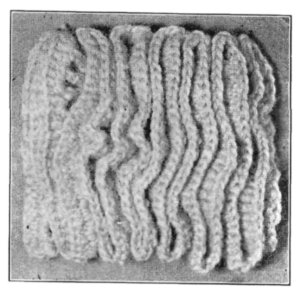
Source illustrationAbout this image
The source illustration shows wristers with decorative crochet rows. This modern version leaves the knitted tubes plain.Historical pattern · Modern adaptation
Ribbed wristers
A short tube in 2 × 2 rib, based on a 1918 pulse-warmer pattern. Check the fit on your own wrist as you work.
Before you begin
Materials
- Knitting-worsted or another yarn with suitable needles
- Four double-pointed needles, with three holding the stitches and one working, or a circular needle for small-circumference knitting
- Tapestry needle and scissors
- Measuring tape
Quick reference
Abbreviations
- K2
- Knit the next two stitches.
- P2
- Bring yarn to the front and purl the next two stitches.
One step at a time
Step-by-step instructions
- 1
Measure and swatch
Measure around the hand where the wrister will sit. Knit a small K2, P2 swatch and stretch it gently. The historical source does not give a modern yarn weight, gauge, or finished circumference, so use your swatch to judge whether the fabric can stretch comfortably over your hand.
- 2
Cast on 60 stitches
With four double-pointed needles, cast on 20 stitches on each of three needles. Use the fourth needle to knit. Join to work in the round, checking that the cast-on edge is not twisted. This modern edition chooses 60 stitches from the source’s 18–22 per needle range so the K2, P2 rib repeats evenly.
- 3
Work the rib
Repeat knit two, purl two around. At the end of the round, check that the ribs line up and that no stitch has slipped between needles. Continue for about 35 rounds, or until the wrister reaches your chosen length.
- 4
Try it on as you go
Slide the work carefully over your hand and check that it stretches without pinching. Add or remove rounds for length. If the tube is too tight or loose, undo it and adjust the stitch count in multiples of four after checking a new swatch.
- 5
Bind off loosely
Bind off in pattern, keeping the edge loose enough to pass over your hand. Weave in the ends. The source describes decorative crochet rows worked from top to bottom over the knitted piece. This edition omits those rows and leaves a plain tube.
- 6
Make the second wrister
Repeat the same steps for a second wrister. Compare its length and stretch with the first before weaving in the ends.
Modern adaptation. Check materials, measurements, and gauge before beginning.
Historical pattern · Modern adaptation
From Handbook of Wool Knitting and Crochet
Original heading: Wristers or Pulse-Warmers · “Wristers or Pulse-Warmers,” printed p. 14
Read the original wording and adaptation notes
Original wording
Using knitting-worsted, or yarn of any desired size or quality with needles to correspond, such as would be employed for a man's knitted sock, cast 18 to 22 stitches on each of 3 needles, and knit 2, purl 2, alternately, for 35 rows or more, according to length required. Bind off loosely. With bone crochet-hook work in straight rows from top to bottom, putting a treble in every other stitch and 2 chain-stitches between trebles; after the last treble at the edge chain 2, miss a row and return on the next. Having completed the rows of spaces, make 2 trebles in 1st space, 3 in next, and repeat, working back and forth until all the spaces are filled.
What changed for this modern edition
- The source’s 18–22 stitches on each of three needles do not all make a stitch count divisible by four. This edition selects 20 per needle, 60 total, for a consistent K2, P2 round. The change is stated here rather than presented as source wording.
- Modern steps use the source’s 35 rows as a starting point, but describe rounds because the work is joined for a tube. Check length and fit on the wearer; no sizes or gauge are provided.
- The source describes decorative crochet rows worked from top to bottom over the knitted piece. This edition omits those rows and leaves a plain tube.
- The modern instructions have not been physically sample-tested.
View the original source illustration
Public domain in the USA. Rights status can differ outside the United States.
View the digitized book at Project GutenbergThe title page names the publisher and 1918, but no author. A nearby advertisement names a different book and is not evidence of this handbook’s authorship.
Maker notes
Your shelf
Sign in to save projects across devices and share your making.
Finished projects
No makers have shared a finished version yet.
Questions and notes
No comments yet. You can be the first to share a useful note.